From Dominion to Deception: How Authority Was Twisted
- Shannon Perry
- May 18
- 6 min read


Preparing for the Global Repentance Mandate — Article 3
By Shannon Perry
Rebellion does not begin with chaos. It begins with a quiet relocation of authority.
In the first article of this series, we returned to the garden to examine the original betrayal — not as a simplified story about fruit, but as the moment divine order was rejected. In the second article, we traced the sound that rebellion releases and how heaven responds by raising watchmen before judgment falls. Now we must move beneath both of those realities and examine the hinge that holds them together.
What was actually fractured in Eden?
Because if we misunderstand the fracture, we will misdiagnose everything that follows.
The fall did not begin with appetite. It began with governance.
Genesis introduces humanity not with restriction, but with entrustment. “And God said, Let us make man in our image, after our likeness: and let them have dominion…” (Genesis 1:26, ASV). Before there was a prohibition regarding a tree, there was a commission regarding the earth. Before there was warning, there was authority.
The Hebrew meaning behind the English word dominion carries the sense of delegated rule — authority exercised under a higher throne. Adam was not autonomous. He was entrusted. His authority was real, but it was derivative. It flowed from alignment with Elohim, not independence from Him.
The order was simple and unfractured. Elohim ruled. Humanity represented. Creation responded.
Dominion in Eden was not domination. It was a reflection. Humanity bore the image of Elohim — not to rival Him, but to mirror Him. The Hebrew meaning behind the English word image suggests representation, likeness, imprint. Authority flowed from alignment with the One being reflected. Humanity did not invent truth; it stewarded it.
There was no insecurity in the garden. No competition. No manipulation. Authority did not need enforcement because it was rooted in submission. When authority is aligned, peace follows.
This is why Genesis records that the man and the woman were naked and unashamed. They were vulnerable, yet unthreatened. Exposure did not produce fear because the covering was intact. Shame has no legal foothold where authority remains properly ordered.
Genesis 2 deepens the picture. “And Jehovah God took the man, and put him into the garden of Eden to dress it and to keep it” (Genesis 2:15, ASV). The Hebrew meaning behind the English word keep includes guard, preserve, watch over. Adam was not passive. He was responsible for maintaining order. Authority was relational, not positional. It flowed from proximity. It was sustained by trust.
And then a question entered the garden.
“Yea, hath God said…?” (Genesis 3:1, ASV).
The serpent did not begin by denying Elohim’s existence. He began by questioning His authority. The first temptation was not pleasure. It was governance. Has Elohim really said? Is His command final? Is His definition of good sufficient?
The suggestion was subtle but seismic. Perhaps truth can be evaluated rather than trusted. Perhaps authority can be examined rather than obeyed.
Then came the escalation: “Ye shall be as God, knowing good and evil” (Genesis 3:5, ASV). The Hebrew meaning behind knowing good and evil suggests determining good and evil independently. It implies moral autonomy — the right to define reality without reference to the Creator.
The temptation was not fruit. It was independence. It was authority without submission.
This was the relocation of the throne.
When Adam agreed, authority did not disappear. It shifted. Scripture later reveals this principle in unsettling clarity. During the temptation of Yeshua, the adversary declared, “To thee will I give all this authority… for it hath been delivered unto me” (Luke 4:6, ASV).
Delivered.
Authority on earth had been transferred through agreement. The fracture in Eden was not merely symbolic; it was jurisdictional. When humanity stepped out from under divine governance, it stepped under another influence.
This is why 1 John 5:19 states, “The whole world lieth in the evil one.” The world did not descend into disorder because Elohim lost power. It descended into distortion because humanity relocated allegiance.
Authority detached from submission becomes coercion. Dominion outside alignment becomes exploitation. The problem was never power itself. The problem was its placement.
The immediate evidence of this shift was not lightning or collapse. It was shame. “And the eyes of them both were opened, and they knew that they were naked… and hid themselves from the presence of Jehovah God” (Genesis 3:7–8, ASV). Before rebellion, they were uncovered and fearless. After rebellion, they were clothed and afraid.
Fear entered where trust fractured. Shame is the awareness of lost covering. Authority misaligned produces insecurity. Insecurity seeks control. Control becomes domination.
This pattern is not only spiritual; it is psychological. It is also institutional.
By Genesis 6, the fracture had multiplied. “The earth was corrupt before God, and the earth was filled with violence” (Genesis 6:11, ASV). The Hebrew meaning behind violence includes injustice, exploitation, abuse of power. Dominion had mutated. What began as personal autonomy became systemic corruption.
Rebellion never remains individual. It organizes itself. It embeds into culture. It shapes governance. Authority misaligned in a heart eventually misaligns institutions.
Centuries later, the same fracture resurfaced in Israel. “Make us a king to judge us like all the nations” (1 Samuel 8:5, ASV). The request appeared administrative. It was theological. “They have not rejected thee, but they have rejected me, that I should not reign over them” (1 Samuel 8:7, ASV).
The issue was not leadership. It was divine reign.
Israel desired visible authority. Predictable structure. Tangible control. They wanted governance shaped like surrounding cultures. Comparison fueled compromise.
Samuel warned them that a king would take their sons, their fields, their labor. But they insisted. Rebellion often disguises itself as modernization.
Saul embodied their desire. He looked the part. He satisfied comparison. But his authority was insecure. When confronted, he rationalized. When threatened, he reacted in fear. Samuel’s rebuke still cuts: “To obey is better than sacrifice… For rebellion is as the sin of divination” (1 Samuel 15:22–23, ASV).
Rebellion substitutes divine authority with human reasoning. Authority without secure submission becomes paranoid. It must defend itself constantly.
The fracture in Eden now governed a throne.
The book of Judges records the logical end of this trajectory: “Every man did that which was right in his own eyes” (Judges 21:25, ASV). That is the inevitable outcome of moral autonomy. When everyone becomes their own authority, unity fragments. Stability erodes. Truth dissolves into preference.
Modern culture celebrates this condition. Self-definition is praised. Autonomy is equated with strength. But the fruit remains consistent: confusion, anxiety, fragmentation.
Civilizations do not collapse because they lack freedom. They collapse because freedom detaches from submission.
If rebellion began with misaligned authority, restoration must begin with realignment. “Trust in Jehovah with all thy heart, and lean not upon thine own understanding” (Proverbs 3:5–6, ASV). Trust is weight-bearing dependence. It is choosing alignment over autonomy.
And James makes the order explicit: “Be subject therefore unto God; but resist the devil, and he will flee from you” (James 4:7, ASV). Submission precedes resistance. Authority functions under alignment.
Many attempt to confront darkness while retaining independence. But authority only operates under submission. The fruit in Eden was never the central issue. The throne was.
The fracture from the beginning confronts every generation with the same question: Who defines truth? Who governs conscience? Who holds final authority?
Authority will always reside somewhere. Neutrality is an illusion. If divine authority is displaced, something else will occupy its seat.
The Global Repentance Mandate begins not with spectacle, but with surrender. Not with outrage, but with realignment. Not with reform alone, but with restored governance of the heart.
The garden was lost through a question.
Restoration begins with a decision.
Coming Next in This Series
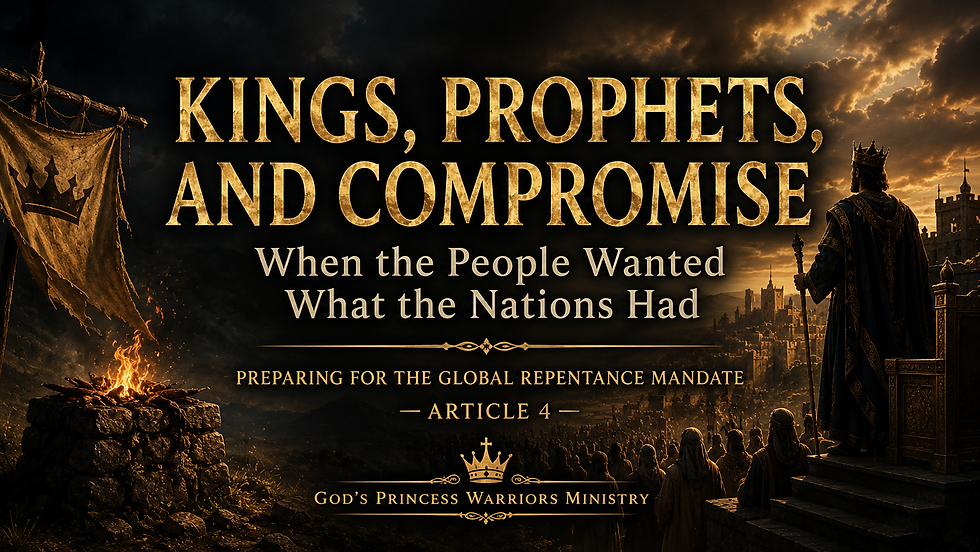
Kings, Prophets, and Compromise: When the People Wanted What the Nations Had
Before idolatry becomes open, compromise becomes normal. We will examine how imitation of surrounding nations institutionalized rebellion — and why the pattern is repeating again.
About the Author
Shannon Perry is co-founder of God’s Princess Warriors Ministry and leader of Remnant Bootcamp, a war-manual-style discipleship and deliverance training. Her ministry was birthed through addiction recovery, deliverance, and the death of her son. She writes and teaches with urgency to awaken the remnant, expose false doctrine, and prepare believers for end-time endurance and obedience.
📱 TikTok: @godsprincesswarriors777
📧 Email: godsprincesswarriors@gmail.com
📞 Phone: 936-402-3124


Very interesting!